Web applications and business management systems
For growing businesses whose records live in spreadsheets, notebooks and chat groups.
Custom systems for records, operations, reporting and customer portals, built around how your business really works.
This service is already chosen when you start from here.
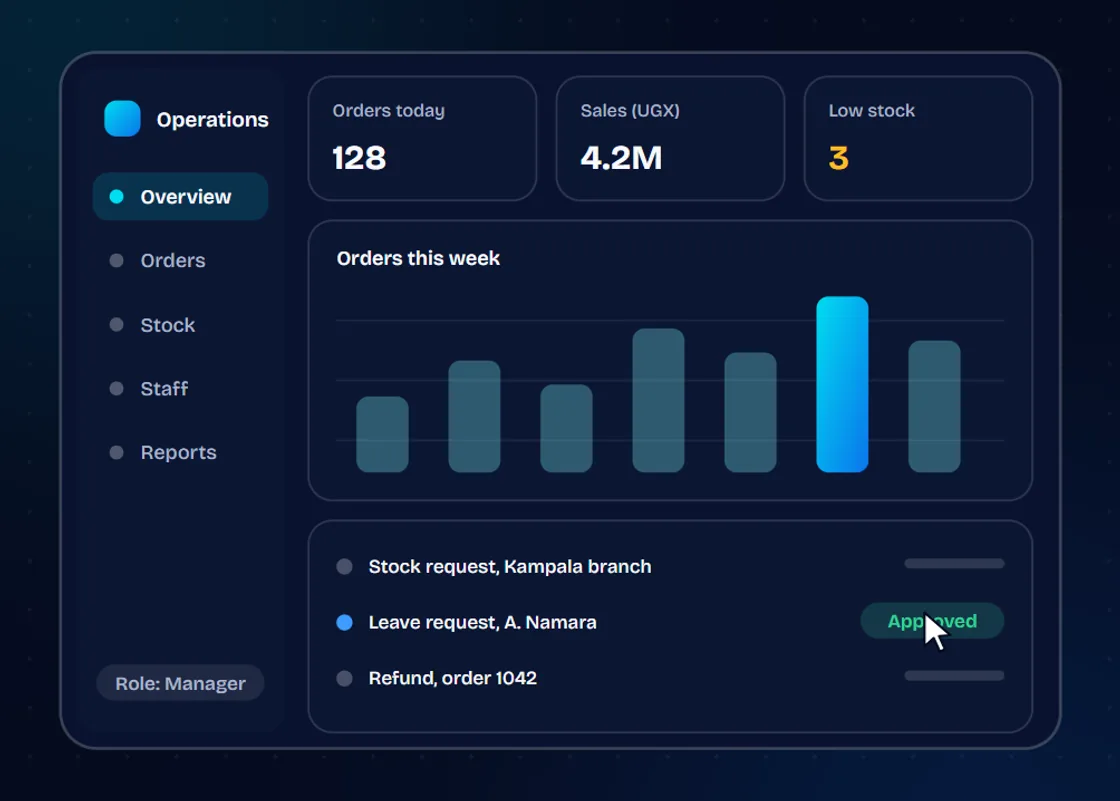
The figures a manager needs fill in, the week's chart grows, and a waiting request is approved with one click.
Problems we usually meet
If one of these sounds familiar, this service is a good place to start.
Reporting takes days and nobody trusts the numbers.
Records are entered once, in one place, and the reports read from them directly.
Branches or teams work from different versions of the truth.
One shared system with roles, so each person sees and edits only what they should.
Customers keep calling to ask for their own information.
A portal where they log in and see their orders, balances or documents themselves.
Moving off spreadsheets feels risky.
We import your existing data, run both side by side for a short period, and release in stages.
What we can deliver
Records and operations system
Stock, jobs, members, patients or students, with daily entry screens and reports.
Customer or member portal
Outside users sign in to see their own records and take simple actions.
Lead and follow-up tracker
Every enquiry saved with its source, stage and notes, like the one behind this website.
Management dashboard
The five numbers a manager checks every morning, updated as work is recorded.
These are kinds of work we take on, not past clients.
In more detail
Spreadsheets and chat groups stop working once a business grows. We build web-based systems that give your team one place to record work, track money, manage stock or members, and see reports without waiting for someone to compile them.
Every system is designed around your actual workflow, with roles and permissions so people only see what they should. Customer or member portals let outside users log in, view their own information and take action without calling you.
We deliver in stages so you can start using the most valuable part early.
How scoping works
Before any price, a short conversation and a written scope. You see exactly what is included before you agree to anything.
We ask
- How the work flows today, step by step
- Who records what, and who needs to see it
- Which reports are compiled by hand today
- What data already exists and where
You receive
- A map of the current workflow and the proposed one
- Roles and permissions: who can see and change what
- A phased plan, most valuable part first
- A quote for phase one
How the price is set
Systems start with a discovery phase that documents your workflows; phase one is quoted from its plan.
Systems projects start with a discovery phase that documents current workflows and produces a phased plan and quote.
Budget and timeline you share in the enquiry help shape the proposal; they are not a price or a delivery promise.
The whole project journeyWhat affects scope and price
We do not publish price lists, because two projects with the same name rarely have the same scope. These are the things that move it, and the scope conversation settles each one before a quote.
- How many workflows and record types the first phase covers
- Number of user roles, and how strict the permissions need to be
- Reports and dashboards, and how much data they summarise
- Importing existing spreadsheets or data from an older system
- Portals for customers, members or partners
- Connections to accounting, messaging or payment services
- Training, documentation and the improvement plan after launch
How delivery runs
Discovery documents how the work flows today and what the system should change. Phase one is scoped around the part that saves the most time, designed as screens your team reviews, then built with weekly previews and a copy of your real data. Testing runs with your own team before launch, and later phases are scoped once the first one is in daily use.
- DiscoveryA conversation about your business, not a sales pitch.
- ScopeThe idea becomes a list you can read and price.
- DesignYou see and click it before anyone writes code.
- BuildWorking software every week, not a surprise at the end.
- TestingChecked on real phones and slow connections before launch.
- LaunchLive, in your name, with a handover.
- SupportSoftware keeps working after the launch excitement.
We have built this kind of thing
Questions owners ask
Can we start small?
Yes. Phase one covers the part that saves the most time; later phases are scoped when you are ready.
Where is our data stored?
In a managed database in an account you own, with backups. We explain the choice in the proposal.
Can it work with our accounting software?
Often, if the software offers an API or export. We check this during scoping.
Ready to scope this?
Tell us what you need in the guided enquiry. It takes a few minutes on a phone and you get a reference number straight away.