Custom mobile apps
For businesses whose customers, agents or members work mostly from their phones.
Android and iOS apps built with Flutter from one codebase, from first prototype to app store release.
This service is already chosen when you start from here.
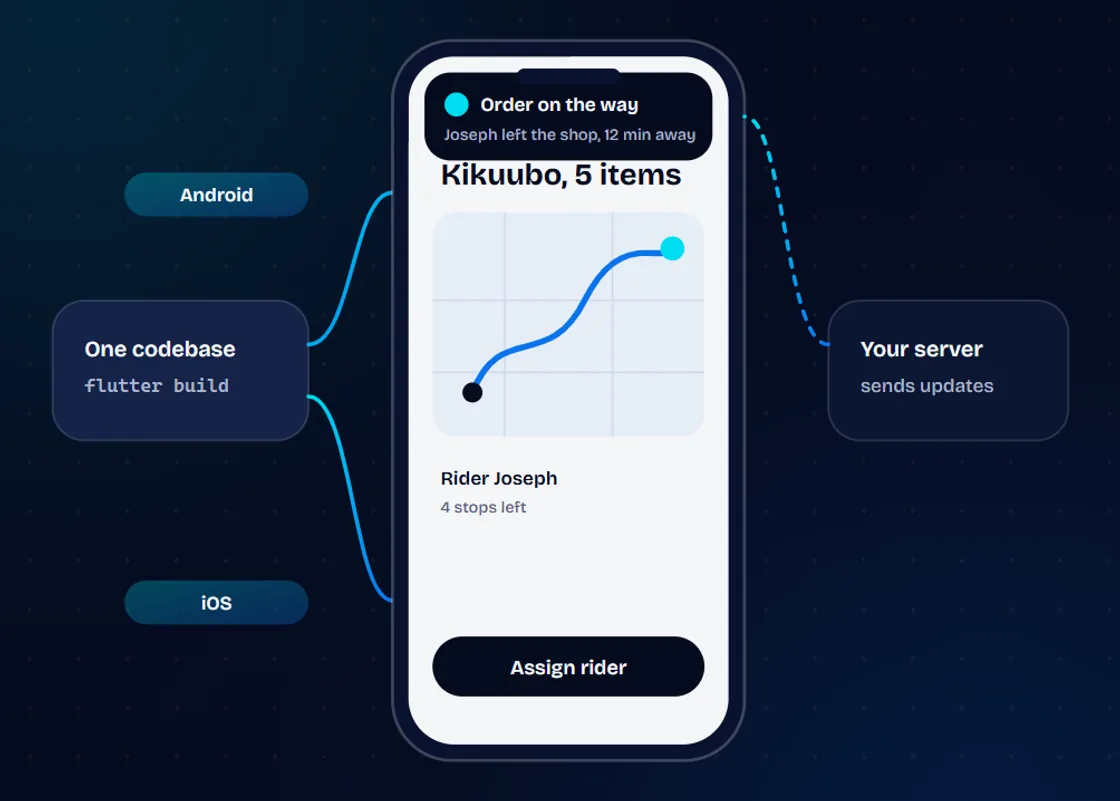
One codebase becomes your Android and iOS app. A tap opens an order, the route draws, and an update arrives from your server.
Problems we usually meet
If one of these sounds familiar, this service is a good place to start.
Two apps, two teams, two bills for Android and iOS.
One Flutter (or web-plus-native) codebase for both, so fixes and features ship once.
Field staff lose work when the signal drops.
Records are saved on the phone first and synced when there is a connection.
Store submission keeps getting rejected.
We prepare the listing, privacy policy, data-safety answers and account-deletion page the stores ask for, before submission day.
You have an idea but no way to test it cheaply.
A clickable prototype first, then a first release with only the features that prove the idea.
What we can deliver
Customer ordering app
Order, pay, follow the delivery and see past receipts.
Field data app
Agents record visits, photos and locations offline; managers see it synced.
Member or loyalty app
Members check balances, benefits and notices, with push notifications.
Internal operations app
Stock counts, checklists or approvals for staff on the move.
These are kinds of work we take on, not past clients.
In more detail
We build mobile apps for businesses that need to reach customers or staff on their phones: ordering, bookings, field data collection, loyalty, member services and internal tools.
We use Flutter so one codebase runs on Android and iOS, which keeps costs and maintenance sensible. Apps connect to a secure backend for sign-in, data and payments, and we handle the store listings, testing tracks and releases.
We have shipped our own apps through the same process, so we know what Google Play and the App Store expect before submission day.
How scoping works
Before any price, a short conversation and a written scope. You see exactly what is included before you agree to anything.
We ask
- Who uses the app, and what they do in it most often
- What must work without internet
- Which accounts, payments or notifications it needs
- Whether you already have a developer account with Google or Apple
You receive
- A screen map and a clickable prototype of the main flow
- The first release's feature list and what waits
- Backend, sign-in and store-release plan
- A fixed-scope proposal for the first release
How the price is set
Apps begin with a scoping sprint; the first release is quoted from the prototype and screen map.
Apps begin with a scoping sprint that produces a prototype and a fixed-scope proposal for the first release.
Budget and timeline you share in the enquiry help shape the proposal; they are not a price or a delivery promise.
The whole project journeyWhat affects scope and price
We do not publish price lists, because two projects with the same name rarely have the same scope. These are the things that move it, and the scope conversation settles each one before a quote.
- Number of screens and user roles in the first release
- What must work offline and sync later
- Sign-in, payments, notifications and the outside services it connects to
- Android only, or Android and iOS
- Whether a backend already exists or needs to be built
- Store accounts, listing assets and the policy pages the stores require
- Testing on real devices, and the support plan after release
How delivery runs
A scoping sprint produces the screen map and a clickable prototype you try on your own phone. The first release is then built in short cycles with a test build you can install, while the backend and the store paperwork are prepared alongside it. Release goes through your own Google Play and App Store accounts, followed by a support plan that covers store and operating-system updates.
- DiscoveryA conversation about your business, not a sales pitch.
- ScopeThe idea becomes a list you can read and price.
- DesignYou see and click it before anyone writes code.
- BuildWorking software every week, not a surprise at the end.
- TestingChecked on real phones and slow connections before launch.
- LaunchLive, in your name, with a handover.
- SupportSoftware keeps working after the launch excitement.
Questions owners ask
Do you publish the app to the stores?
Yes. We prepare the listing and release it through your developer accounts, so the app stays in your name.
Android only, or iOS too?
Both from one codebase. Many of our clients' customers are on Android, so we usually release there first.
What happens after release?
Store updates, operating-system changes and bug fixes are covered by a support plan, or handed to your team with documentation.
Ready to scope this?
Tell us what you need in the guided enquiry. It takes a few minutes on a phone and you get a reference number straight away.